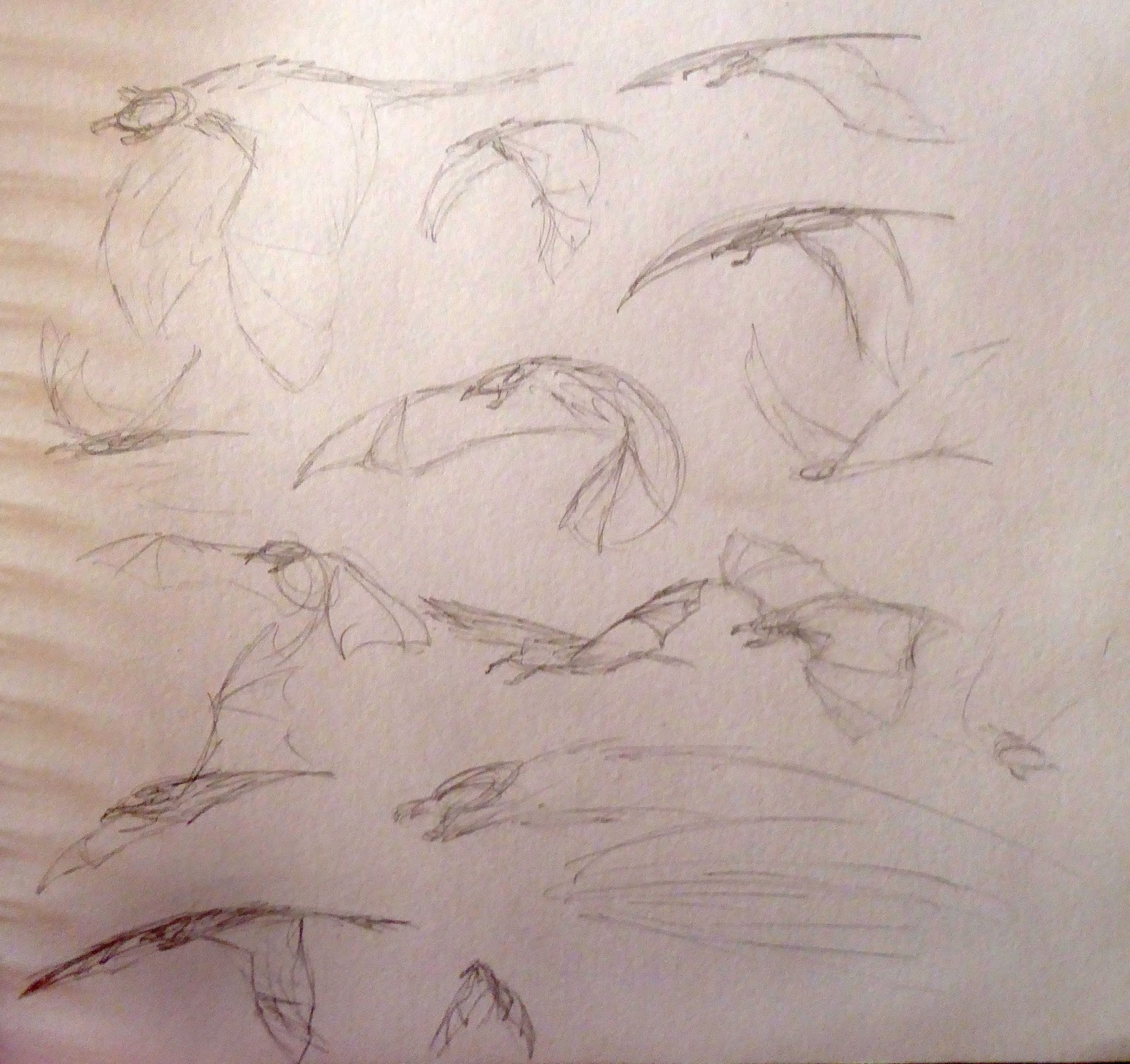
Thursday, 5 May 2016

More Sketches

Drawings completed since the last mass sketch-dump. Sometimes touches on creatures I was finalising at the time, while others are ideas for potential creature designs for in third semester.

I've also been reading my encyclopaedia of mythical creatures, and the ones I note down are starting to come together to form interesting creatures in their own right. For my next designs I want to develop interesting relationships and dynamics between multiple creatures, and make sure they stand alone as at least partly recognisable in mythology, though subverted.

Sketches
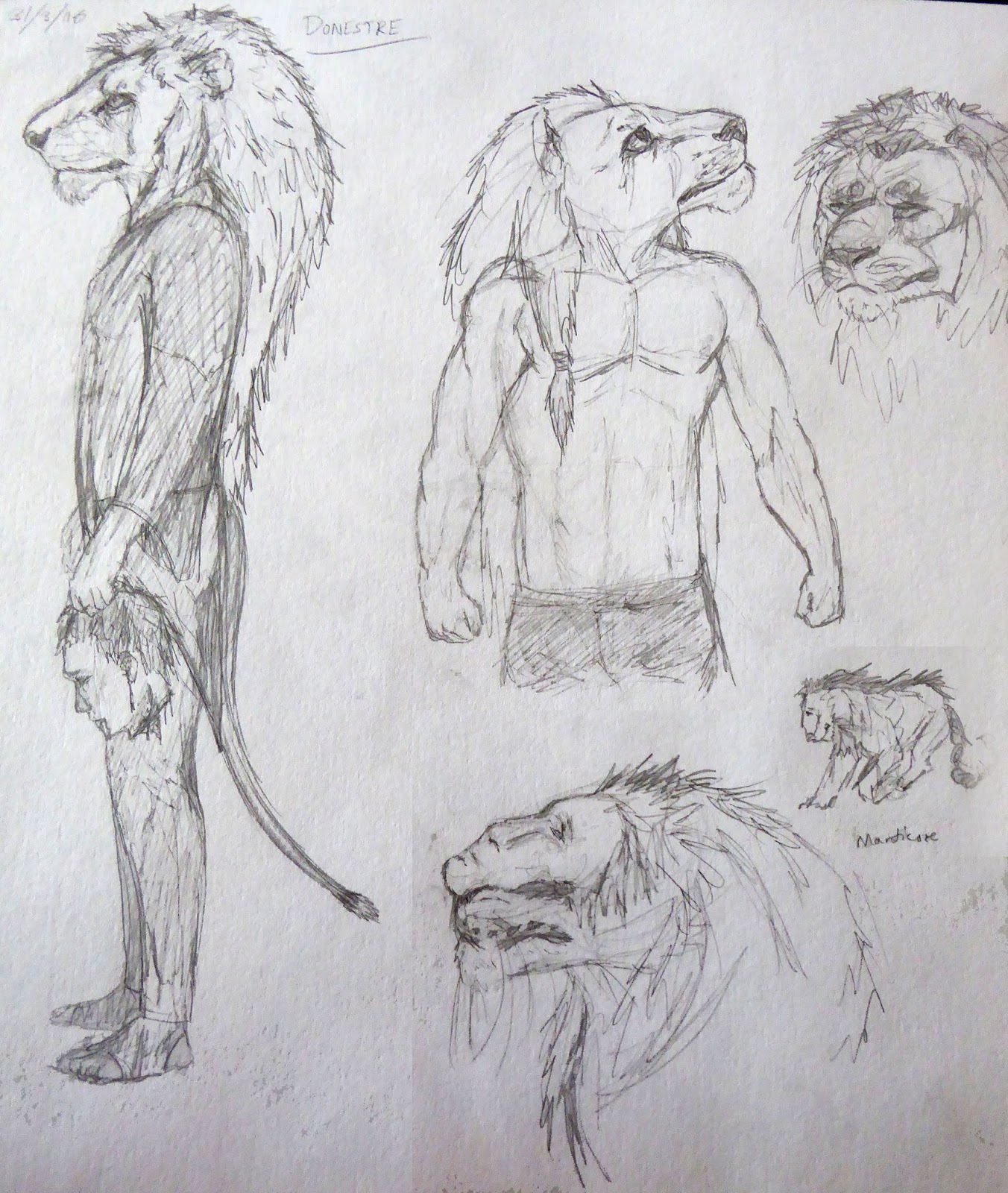
Concepts of the Donestre, a creature said to have a man's body and a lion's head. When it kills and devours someone, it eats up to the head and then sobs over it. The bottom right is an idea for a manticore, a lion-bodied creature with the face of a man; I wanted a different twist to simply replacing its whole head with a human's.

Concepts for a tar/marsh-dwelling stag-like creature. Long legs enable it to reach the bottom of the viscous material and wade through. Locals treat it as a curious god, and place masks on its faceless antlers to show their respect. Lower sketches are various shape explorations.

Main idea; creating a small shape in red brush pen, and working around it with the fineliner. It made for some really interesting shapes and I'd like to work on a few of them. The bottom black sketches are exploring a creature that dips its front feet in tar to bind them together, possibly to give it a more formidable strike.

Continuing with previous idea. Also considering field-based griffins; kestrel/rabbit/secretary bird hybrids. Lower black sketches are working within the boundaries of the dry brush effect I had, and looking for shapes.

Spiders and mushrooms were a vague inspiration for some here. The lower right images are built from more complex red brush pen shapes, and outlined with the slightly darker red fineliner. It's a very interesting way to add slight detail without detracting from the silhouette.

Top: idea for a 'mother' creature, which spirits away babies of other creatures, and murders the guardian. Heads of such guardians are kept alive on spines on its back, using protrusions like ribbon-worm tongues to latch into the nerves and keep it 'alive'. Possibly its head is capable of 360 degrees like an owl, so it could place a chosen head from its collection onto a prong and wear it to interact with its 'child'.
Lower: Unicorns. Based on the idea of them having lion-like traits (tail, mane) in heraldry, and pushing it further to make them a more predatory animal.

Lathrid creatures. Possibly to take the role of mounts in the world I want to design in my next project. Chameleon-like feet for grip when climbing, and a love of shiny jewelry and piercings. The bottom headshot is from this creature design, made to add notes to whilst researching.

Drawn when there were no computers free at university. Randomised sets of three animals were written down from an internet generator, and then I used what knowledge I had of the animals to try and make interesting creatures. The rat/warthog was a particular favourite, as was the dingo/bighorn sheep. It made me consider simpler ideas for future designs, and the range of sizes my creatures could be.

Sketches working out how a two-headed dog like Orthos might be made different. Its second head is tucked up in its neck, with its jaws resting behind the main head's. The lower sketches are from this creature design, looking for a pose.

More ideas for Orthos. The idea of an imperfect, chimeric double face like Janus is considered, but it seems an easy conclusion. Also designed a snake (began as a lizard) that lurks as a branch, with a flower-like mouth, to lure in prey. It has a relationship with leaf-like bugs that rest on it without fear, looking like buds and adding more credibility to the creature being a real branch. In turn they are protected from animals that might try to eat them. Additionally, I was watching a documentary that featured dinosaurs with pressure sensors, and titanic herbivores that grew due to expending little energy and taking in vast amounts. I feel they will add to future designs.

Reflection

  • Need to do more watercolour, and possibly extend the range of colours used. Maybe gouache or acrylic, too.
  • Definitely want to model with clay in the near future.
  • I swap between brush pen, fineliners, and pencil; sometimes it's from using one constantly, and I want a change, but mostly I use the tool I feel is best for what I'm trying to achieve. Pencil is for sketching ideas of creatures I have a better sense of and can put details onto, whilst the brush pen is for blocking out shapes and finding interesting silhouettes, which the fineliner can begin the detailing on.
  • Articles and documentaries are useful in ways I didn't imagine, as they give a trivial piece of information that could shape a whole creature design.

Wednesday, 4 May 2016

Creature Design - Anba

Overview

This creature, like the Ostrad, was a long and arduous process to finish, and I'm still not satisfied with how it turned out. The idea is that it is a manta ray crossed with a bat, and lives a peaceful life of just eating whatever comes into its mouth, whether its in the air or underwater. The hard part was trying to achieve this behaviour in a single pose.

Anba is from what my files are all named - manta-bat. 

Inspiration

Creatures:
  • Manta Ray
  • Fruit Bat
  • Whale Shark
Considered:
  • Axolotl
  • Barioth (Fantasy - Monster Hunter Tri)
  • Jhen Mohran (Fantasy - Monster Hunter Tri)

Process

This may have been the most tedious creature I designed purely through my own incompetence at figuring out perspective and poses. The actual idea was solid and I was happy with the design, it just required more knowledge of perspective than I could gather in the given time-frame, and for that reason it became irritating and took a while to complete.

Initial sketches. As is clear, a pose was hard to come by, but the design was fairly solid and worked out.

More exploration of the design (bottom left), and searching for a pose. Chosen ones were beginning to be coloured and then discarded as they weren't good poses. The top is wrong anatomically, and the middle didn't give a good sense of scale or behaviour.

Resorting to traditional methods to find a pose.

Final image. Found a sedate, gliding bird pose and used it as reference. It didn't correlate with bat wings, so it still feels off. However, colours and head-shape evolved from being constantly drawn, which was a bonus.

Design Notes:
  • Has a wide, whale shark mouth that is constantly open and waiting for prey
  • Has no feet
  • Spends the majority of its life in the air, gliding on powerful air currents and expending very little energy
  • Sleeps in the ocean, using its wings as flippers to get in and out. It has gills hidden under its fur. Some have been known to fully convert to the ocean life and do not go back into the air
  • Can grow to a colossal scale as so little energy is used to keep itself afloat
  • Surprisingly light, for its size - hollow bones and air sacs keep it buoyant
  • Sometimes dies in the air, suddenly, and crashes to the floor. Humans crave the gold and precious gems that make up its carapace-like head.


Reflection


  • Definitely need some sort of physical reference for winged creatures. I think, should I do another one, I will create small mock wings out of pipe-cleaners and paper or something similar, to have something to efficiently model and pose. I did end up making a flat paper model but the joints and movements were impossible to mimic properly with the limited resources available at the time.
  • Fairly irritating creature due to my own ineptitude with perspective. However, I am much more knowledgeable about the skeleton behind bat wings now.
  • Useful to complete to the end, even if it isn't the best result.
  • Hopefully I can redo it in the future and see the improvements once I've tried more winged creatures and figured out more tricks to work out positioning.
  • Hindered by needing a gliding pose; most bat references were not flat winged, and those that were didn't have the correct body positioning I wanted. A more action-based pose would have been easier to pull off but wouldn't give this creature the correct feel, which was to be gentle and gliding. Constraints of keeping within the page limits affected the pose also.
  • Navigator was used again to make sure the silhouette was acceptable, if not the best.

Creature Design - Ostrad

Overview

A creature based around the idea of it having huge front feet capable of smashing rocks. It underwent a lot of changes during the development, and for this reason it took a lot of time to complete as parts were awkward and didn't reach a viable conclusion until a lot of thought had been put into it. The end design is not where it was originally going but as a creature aiming to be believable it probably works better this way.

Named for ostracods, abyssopelagic fish that glow with bioluminescence and can spit the same as a deterrent to predators. They were the original inspiration behind this creature.

Inspiration

Creatures:
  • Bull (particularly the Spanish Bull)
  • Spiny Lizard
  • Elephant
  • Fennec Fox
  • Blue Whale
Considered:
  • Hermit Crab
  • Horseshoe Crab
  • Butterflies, moths and caterpillars with eye-spots, i.e. Monarch, Peacock
  • Pacific Barreleye
  • Narwhal
  • Manta Ray
  • Abyssopelagic creatures, i.e. Toimopteris, Dragonfish
  • Ostracods
Ostracod fish shooting bioluminescence as a predation defence.

Process

This creature took a lot of different turns. It started out being a very basic idea of a crab/bull, but nothing worked so it was quickly discarded. However, the idea of a bull stuck, and it developed over several weeks during various attempts, and ended up being a fairly interesting design.

Initial sketches for a crab/bull. If it led down, its armour was to cover it entirely. The idea of projecting front feet is covered at this stage, which stuck later.

Sketches after R.J. Palmer's first Skillshare video. The bull is clearly explored in the bottom right. Eye-spots and armour are considered.

Took the favourite bull sketch and moved back to the proper design page. Drew a proper bull for practice, and get a sense of its muscles. Big front feet quickly developed as a favourite concept. Back legs took longer to decide on. Eye-spots are considered at a sketch stage, alongside different poses.


The idea here is that the Ostrad has glowing eye-spots along its body, to deter predators, and can spit an airborne version of the ostracod fish's bioluminescence. It didn't set right, as the designs did not fit such a big creature, and often stalled the design process.

Eye-spots are attempted, as is a red flush when the creature overheats (desert/mountain climate). Concepts stalled. Returning, the pose was altered to be more like walking, the previous ones looking unnatural and dipped. Pushed forwards with the bioluminescent idea, using abyssopelagic fish as reference images.

Changing horns. First idea seemed too tentacle-like, almost movable. I expect it was based on a butterfly's proboscis but it didn't suit such a big animal. The looping back idea felt different and usable. Features glowing bioluminescent scales and peacock butterfly colours.

Eyes added to just behind mouth, like a whale. Barreleye-like transparent bubble head tested under the horns, where the bioluminscence to be spat would shift and glow. Felt too spacey. Used the navigator function on Photoshop to see the creature's silhouette as a whole, which helped greatly. Eventually took away the glowing dots and brought it to a simpler, sandy/pinkish desert-dwelling animal colour.

Finding a solution for its head design: the Ostrad smashes rocks with sulphur veins, and generates a carbon disulphide mixture (found naturally in volcanic/marshy areas) to extract sand from sulphur. The sulphur is stored in its neck-pouch, and can be ignited (when spat) by a flick of its whip-tail, to hurt enemies. Sand is stored in its hollow, red horn, and can be blasted out at high speed at will, to blind predators.

Final image. Fitting the creature into the background was difficult.

Design Notes:
  • Stores sulphur extracted from smashed rocks in its crop, removing sand from the mixture with a carbon disulphide mixture its body can produce. Can ignite sulphur with its whip-tail. Has been known to melt rocks into a more managable size with carefully placed sulphur
  • Stores sand in its headpiece, and can utilise it as a sandscreen to blind predators
  • Massive forearms create a huge amount of pressure, can smash through giant boulders with enough determination
  • Will try to crush/kneel on enemies if provoked
  • Typically peaceful and passive. Very protective of children
  • Can get sunburnt, though rarely. Will sit in shade or roll in mud to cool down during heatwaves

Reflection

  • Took a very long time to finalise. It got fairly irritating at times, but I had no intention of giving up as it was not too lost, just difficult to figure out.
  • Reworking so many aspects of the creature multiple times meant that the original vision was lost. I think I preferred the version that utilised bioluminescence but I don't think it could work on a creature of this intended size and scale.
  • Using a background - the final effect is better but the sized version gave more of a sense of scale, and kept all interest on the creature.
  • Photoshop crashed multiple times towards the end of this piece; the final image is more pixellated as it was salvaged from a screenshot, and I hadn't wanted to lose the work I'd put into it.
  • Using the navigator at the side of the screen is very useful for getting a sense of the whole piece, and definitely helped to keep this creature with a workable silhouette.
  • It looks more alien than I wanted. I'm not hugely happy with the result but I came to this end as I couldn't make what I wanted work, so this is really the least objectionable result.

Creature Design - Werewolf

Overview

As covered in my Research Study Report, I realised the usefulness of following ideas through as soon as I had them, and not saving them for another time. The process of doing initiates learning, and this creature was borne of that philosophy. As the majority of my creatures are made to subvert expectations, I was trying to think of how a werewolf could be redesigned to be different, away from the likes of Twilight, the Wolfman, and Van Helsing.

Inspiration

Creatures:
  • Werewolf (Fantasy)
  • Hyena
  • Human
  • Staffordshire Bull Terrier

Process

Typically, in fantasy werewolf transformations, the given idea that when all the bones extend and deform, the skin expands to grow over it. The film 'Van Helsing' featured human skin covering the transformed wolf, and had to be torn off, which was an interesting twist and probably bled into this unconsciously. My idea was that the skin is finite, and would be left ripped and torn on the body, giving the werewolf a much more grotesque visual and taking it back as a creature to be feared; werewolves tend to embody the duality of man, and how one can fall into the nature of the beast. This creature very much intends to show how it is not a desirable condition.

Initial sketches. The human was drawn to get a sense of typical proportions, to see what parts I would be extending for the wolf. I had multiple skeletons and musculature reference images.

 The pose came out immediately, as I wanted to fully reference muscles and bones and was unsure I could do that with a more twisted, action-based pose. Additionally, this pose seemed to give it a pained, stalking look.

Final image. The fur took a long time to complete as I referenced it properly and discovered I drew wolf fur wrong. I was inspired by 'The Jungle Book' concept art (Annis Naeem) to try and push the realism in this illustration, thus the background to set the scene was included. 

The skin tears were difficult to reference; I used a couple of upsetting dog fight images for blood in fur, and either an autopsy or surgery image that featured a surprising amount of blood clots. I don't know how true to life it would be (I assumed such wounds would drip blood but couldn't find suitable references), but I like the outcome I referenced more than one I guessed at.

Final image. Shaft of moonlight added to brighten the image and make the gore more visible.

Design Notes:
  • Thumb takes place of dew claw, fingers bent into more paw-like shape
  • Tail short, like vestigial tails on humans
  • Skull is partially exposed as it would tear through the human face during transformation. Other rips are random in areas where bones would shift
  • Heel gains a protrusion like in wolf skeletons
  • Shoulders are half human shoulder-blade, and half wolf, thus why they are such prominent features
  • Hunting probably based on sight as its nasal passage is unsuitable for scenting now
  • Probably a one-way transformation; blood-loss and shock might lead to an early death

Reflection

  • Took a while to finish due to the attempt at a more realistic, referenced creature, with fitting background.
  • Definitely was a fun experiment to try out, and fast from initial conception to execution.
  • Aided knowledge of wolf fur patterns, anatomy, how to push anatomy to  its limits, and how to draw open wounds and muscles.
  • Need to look into backgrounds more. This one was a happy accident with the colours chosen, and is intentionally blurred as I don't have enough knowledge to add to the piece with detail. It simply serves as a setting for my creature and is not trying to take the attention from him.
  • I'm glad I pushed the realism more, even if the reference images were unpleasant to research and look at.

Wednesday, 20 April 2016

Quick Catch-up

Of Creatures

Manta Ray/Bat Creature
  • Paused
  • Need to rework the pose again as the perspective is still off
  • Has a paper model (used for previous poses)
  • On hold till a fitting pose has been found
Ostracod/Bull
  • Paused
  • Research is being done - figuring out patterns of bioluminescence on ostracods and abyssopelagic fish to make it most effective on the end creature
Werewolf
  • Requires finalising and adding to the blog


Other

  • I've been reading an encyclopaedia of mythical creatures and am marking ones I find interesting, in order to possibly sketch and draw them later
  • Looked at OpenToonz; with enough motivation and decent tutorials, I might be able to utilise this animation software for a creature's walk cycle
  • I hope to complete three skillshare courses once my current three creatures are finished
  • I've been doing a lot of traditional sketches and silhouettes again, I've found that a red brushpen and fineliner have an excellent effect when paired together, and I have a few creature ideas developing from it. I'll post those when I have a few more pages done

Monday, 4 April 2016

Creature Design - The Giant

Overview

This creature stalled a lot during creation, but eventually came through as a gentle giant. Reminding myself of a favourite documentary helped immensely to finish this creature to a respectable, realistic standard, and it's now one of my favourites instead of something I regretted trying.

[Unnamed properly as of yet.]

Inspiration

Creatures:
  • Bull
  • American Buffalo
  • Golden Takin
  • Elephant
  • Nudibranch
  • Snail
  • Nautilus
  • Ammonite (Extinct)
Other:
  • Sundew Plant


Considered:
  • Hammerhead Shark
  • Fu Dog (Fantasy)
  • Dunkleosteus (Extinct)
  • Diplocaulus (Extinct)


Belated Afterthoughts:
  • Walrus
  • Barnacled rocks

Process

The Giant started out as an attempt to revive the fu dog/diplocaulus creature I'd begun with at the start and abandoned due to lack of direction. Later on, I left this creature design again as I didn't know how to progress in it. Each time, I came back and persevered and eventually everything worked out.

Original idea, hammerhead shark/diplocaulus/fu dog. Though some of the shapes are interesting, nothing was inspiring enough to continue with.
 
Favoured sketches from previous page on the left. Added in the Golden Takin as a source of inspiration due to its domed head shape. Righthand sketches are where I included bulls and nautilus; this is why the horns are swirled, to give the spiral shell pattern on the side of the head.

Final lineart. Of the two coloured sketches, the left one is where this creature stalled again. The right one, with more depth and feeling, was when I came back to it. Continuing it as a bland, sharkskin-esque texture felt wrong - elephant skin was soon taken as an inspiration and the design propelled from there. This is why the righthand lineart has elephant trunk lines on its head, as I had completed the left image by then and was preparing the second lineart for the same.

During colouring, I had to invert the textured background as it was too overbearing on the colours I was choosing to use, and I couldn't see the edges very well against the sandy tones. The blue it happened to invert to gives these creatures a very cold, arctic feel, as though they are stalwart wanderers of the snowy plains, and this idea and visual may have influenced their colours subconsciously.

Final design.

Design Notes:
  • They have no eyes. Their foraging depends entirely on amazingly strong senses of smell, touch, and hearing.
  • The tentacles on their backs are covered in sticky, sap-like fluid, as are their tail-tips. The tails are used to lash out at prey/foliage, and deposit them on their backs, where they will be devoured. The back-tendrils have serrated edges and towards their base they excrete extremely viscous, strong stomach acid to dissolve whatever matter they have collected.
  • Horns are not used in combat with each other. It is thought they aid in communication though, as these creatures often greet each other with side-on head-touches.
  • Even if crippled by the predatory horses or other attackers, these creatures are still efficient hunters due to the long, swift reach of their tail. Herds will often stay with an injured/paralyzed member and feed them a share of collected food.
  • It is thought they call in extremely low frequencies, as nothing audible is present to human ears. The cat-like Ribas will vacate treetops hours before these creatures will pass by; it is possible they can pick up on the low frequencies due to using some themselves, though not on the same scale.
  • These giants are mild mannered creatures, despite being voracious omnivores. Captive animals can be trained into what they are allowed to eat. They are particularly useful for hauling timber, and some have even been trained to strip bark and branches from the logs also.

Reflection

  • Extremely useful creature to design; not only is it fairly different (especially with the addition of elephant skin as a texture, unused before), but it proves that designs that aren't working can always be turned into something good if you persevere and are willing to make changes.
  • Belatedly realised walruses and barnacled rocks might have been useful to look at whilst colouring. A stronger visual library will fix this.
  • Elephant-like skin is very tedious to draw (though maybe not quite on the same level as scales), but I really like the effect and will probably use create it again.
  • Drawing a side-on creature and then one on a diagonal immediately afterwards was challenging, as some of the design were happy accidents (i.e. a Difference layer being used over the horns with colours that happened to make it much more appealing) that I then had to figure out and recreate. It was very useful to figure out the processes though.

Friday, 1 April 2016

Miscellaneous Sketches

Between my essay and my MA poster I didn't have enough time to focus solely on finished pieces, thus I have gathered a lot of spare sketches and ideas that don't always apply to other creatures in this mini-project. I also have some other creatures to finalise and then add in separate blog posts shortly.

Sketches


Digital sketches based on R.J. Palmer's first skillshare video. Technique is to build shapes first, like a ribcage, and then design a creature based on that, using knowledge of various creatures (his tend to be dinosaurs). Some of mine bled into later creature designs.

Idle sketch of woodlouse armour and fu dogs. From very early on in the project.

Brush pen. Following the idea of a creature that hides as a boulder, with rabbit-like fern ears and other plant-like protrusions that are actually external gills so it could survive underwater. Bottom sketches are of amphipods, something I'd just seen an article on and decided to copy.

Watercolour of said rock/rabbit in its environment. Used a reference. Despite the simplicity, I really like the effect, so I might try basic background details on my next creatures.

Double page spread of ideas for a bull creature with mantis arms that act as a shield, based on the design of an amphipod's armour.
Digital follow-up to the above. The headshots evolved into a more dragon-like creature, however. Both ideas (the head and the body) might come into play in other, later creatures, but at the moment I'm out of ideas for how to progress with either.

Further sketches based on the previous two ideas, breaking off into different creatures.

Break from the previous bull/mantis. Looking for shapes.

Quick sketches from screenshots from my favourite animal documentary, "Return of the Giant Killers: Africa's Lion Kings". I really like the idea of predators taking down huge prey unused to being attacked, and hope to include it in a later idea. Animals included are lions, elephants, pelicans, and buffalo.

Looking at head shapes.

Continuing from the top of the previous image. Digital sketches testing a body style for the creature. It doesn't work out so I left it for now.

Silhouettes of collected animal imagery, looking for shapes and inspiration. The pencil sketches explore ideas of tusks and teeth in different ways.

More silhouettes of creatures, only some from imagery. Chimps/gorilla were inspired by rewatching "Rise of the Planet of the Apes", as I realised I'd never drawn them. The silhouettes to the right of the four apes are using ape head shapes, but upside down.

Coloured brush pens, as a break from black. Found out some have a dry brush effect when used quickly, so I explored different shapes and textures, and what I could read from the end result. I really like some of them as headshots for monsters.

First attempt at Mudbox in almost two years. Tried to recreate Ribas, my sabre-toothed cat creature. Only got one tooth half-done, as I couldn't figure out how to aptly recreate it and get them to a fine point. Also, it was on a high level of detail but the front muzzle, where the teeth should go, was very under-poly. I think I messed up early on and it carried over to the higher detail. Despite ultimately being a failed piece, I did learn a lot (definitely need an orthographic of what I'm trying to sculpt, for instance) and I will probably spend another few days trying again.

Reflection

  • Coming back to traditional art between digital pieces was liberating, and often gave new insight into a design.
  • Exploring headshots is a good technique to make a creature more unique, as gazes focus on the face most, and the body can be built to match.
  • Creature silhouettes were useful to break down shapes.
  • Watercolour was difficult to produce due to limited colour range, but once I realised I didn't have to copy the reference exactly, it became its own piece and I really like how it turned out.
  • I'd like to try clay modelling. The failed Mudbox attempt became annoying due to my lack of experience with the program, and the mistakes I made early on really impacted my ability to finish the piece properly to a degree I was happy with. Clay would be more forgiving, and would give a physical maquette I could use in illustrations, for lighting and pose purposes, like James Gurney uses.