Monday, 4 January 2016

Creature Design - Gravestone Beast and Daren Horley

Creature Design #9

Overview
Developed from a small silhouette I particularly liked, turned into a living/animated statue creature, carved by villagers as a protector that awoke in nightmares and turned on its creators.

I read an article featuring concept art, and the process thereof, of one of the creatures from 47 Ronin. Daren Horley was the artist responsible and his process was explained in the article, so I thought I'd try it. It involved silhouettes, and then greyscale mockups of a final design, with an hour or two spent on each one, before the final thing. Something I didn't try was using a parchment/paper texture to sketch on, to make it more interesting than a blank colour.

Research

  • Daren Horley's article on Creativebloq
  • Nightmare Frontier area on Bloodborne, for tombstone texture references
  • Rock textures (for an overlay layer)

Process
Digital silhouettes based on the idea caused by the top one (from my sketchbook). Looking for a shape for a statue/gravestone nightmare monster.


I took my favourite five silhouettes to the next stage, drawing details in grey over the top. The top two on the left have no overlay texture. By the third, I realised I was spending too much time on gaining an effective rock texture, so I overlaid a texture from google images on low opacity to add necessary variation much quicker. The two rightmost images were put together from amalgamating the best of the previous five designs.


The final image. A walking statue, carved like the gravestones, made as a protector. It bleeds gore from broken stones. Its limbs are covered in moss, mud, and blood.

Reflection
  • My favourite outcome of all of the recent creature designs
  • Using a photo texture in a sketch stage meant there was very little left by the end piece - normally I dislike using photo textures but this one was exceptionally useful and I may do it again in a similar case
  • Horley's method needs testing again with something less greyscale in the end result
  • Spending a few hours on each potential creature meant they were more developed than normal - it took time, but every detail added on them aided the final design
  • Small digital silhouette, scaled up, are easier to make than large ones straight off
  • Very good method for fleshing designs out first, instead of developing details later on


Sunday, 3 January 2016

Creature Design - Werewolf and Hunter, and Andrew Mar

Creature Design #8

Overview
More a change in dynamics than a brand new creature - a hunter and a werewolf working together to hunt beasts.

I looked into Andrew Mar's ink style for this as a more viable alternative to Natalie Hall, as it seemed more doable. He has a skill for placing shadows in the ideal place in lineart drawings and it gives the image a great deal of impact.

Research

  • Andrew Mar's instagram
  • Bloodborne hunters (images)
  • Humans posed facing away (image references for proportions)
  • Wolves snarling (images)

Process
 
The idea was already fairly solid, and explored in previous sketches. These were to find a viable pose to display the relationship between the hunter and his acquired pet.

Chosen pose. They would fight at close quarters, with the werewolf lunging and being pulled back. The chain would eventually snap, so the werewolf would attack with claws from one side, and the hunter would use the remaining chain as a whip. The hunter's design is worn and ragged, showing his strength in surviving his monstrous pet.

Reflection
  • Gives a variety of line-widths to make the image more interesting
  • Can give a suggestion of shadows
  • Time-consuming, gives neat line-art
  • Took a while to find the pose, silhouettes are extremely useful in that regard
  • Waste of time if the final pose looks off or wrong


Creature Design - Church Griffin and Natalie Hall

Creature Design #7

Overview
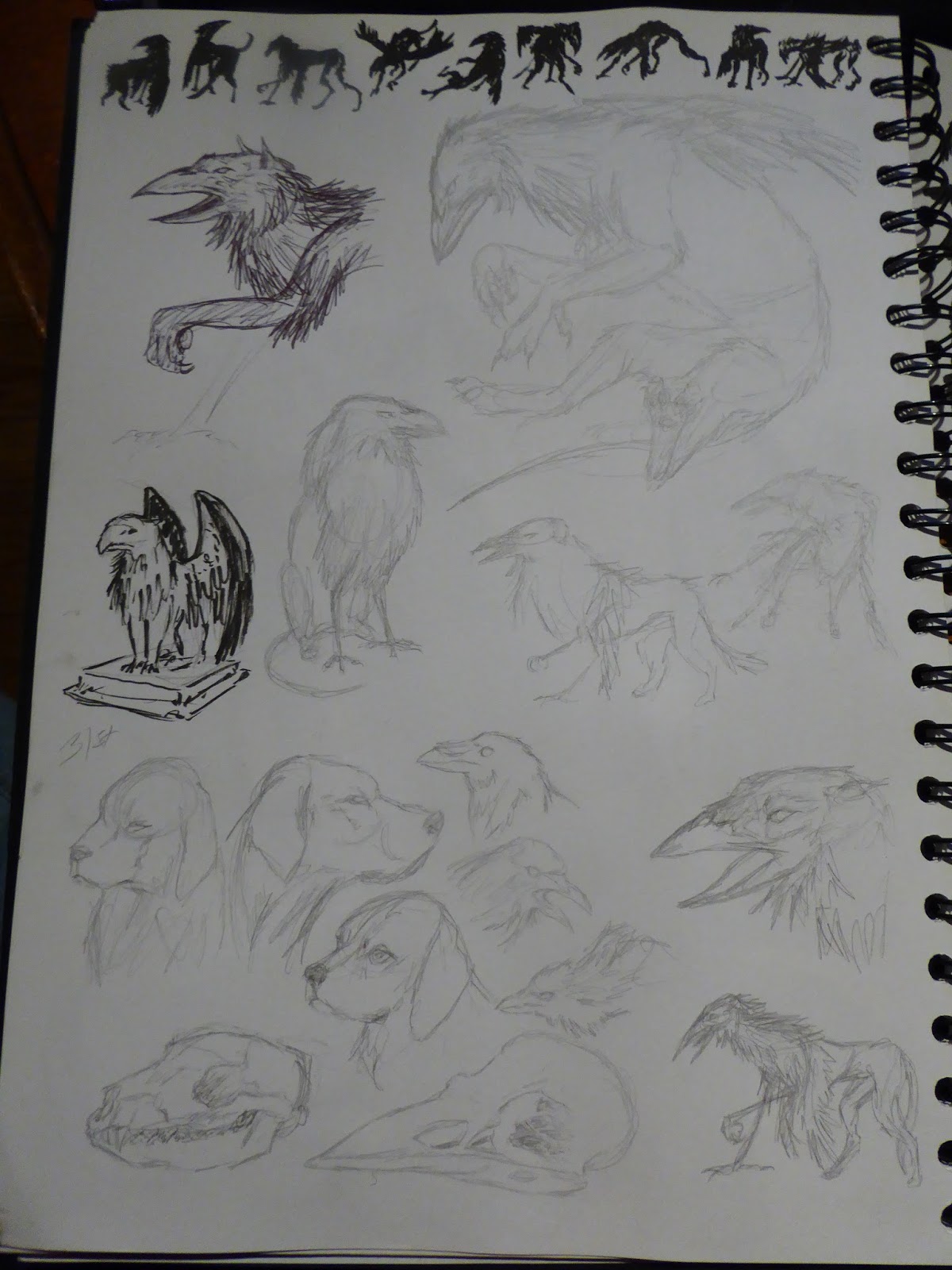
In the Cathedral Ward of Bloodborne there are small griffin statues on pedestals, but the closest an enemy comes to that form is an obviously created dog with the head of a crow; my creature idea was a visible amalgamation of parts into a griffin-like animal, presumably failed and disturbing, and hidden away from the public.

The chosen artist was Natalie Hall, a tattoo artist who often posts animal sketches on her facebook page. She uses pencil and ink, and the results are normally fluid, exaggerated and sometimes in abnormal poses. During my initial sketches for ideas I drew a few creatures in the same kind of style and I thought it might be interesting to expand upon those.

Research

  • Natalie Hall's instagram
  • Fox hounds
  • Crows, ravens, and their skulls

Process
Initial exploration. Since the environment is typically a Victorian-style city, it seemed implausible for there to be lions or eagles. Thus, my ideas stayed with what existed in abundance in the world - dogs and crows.

I tried to use biro like Natalie Hall, which I quickly dropped in favour of pencil again. The small statue is a quick study of an in-game screenshot so I could get a feel for the creature I was designing, imagining the mindset of those who would be making it in the world.

Resorted to brushpen for quicker layouts for an end pose, as it helps me see the overall shape better than pencil lines do. Additionally, drawing in pen means each line counts, and has to be thought through a little more than pencil, as pencil has the option of being erased.

Several of the creatures are consigned to boxes to try and replicate Natalie Hall's style. 

Some poses worked well for forcing a sense of character (in particular, the one throwing feathers, and the one sat on its haunches), but they didn't work overall for displaying a creature's design, though it might be the wings that were at fault. Wings couldn't be folded on its back as it would hide too much of its body, but outstretched didn't fit in the constrained poses. 

The design developed at this stage, also. I went back to pencil, and then drew over it with a thinner brushpen just for line variety. The beak became more combined with the dog's skull, more in proportion with the placement of its nostrils.

Picked the best poses from the previous page and enlarged them, with more detail.

Final design for the Church Griffin. Deformed dog skull protruding into a muzzle, skin pulled back to the back of the jaws, feathers developing into a mane, wings too small to carry the creature in flight, and large crow-like fore-feet. Probably a mixture of hound bays and crow calls for its cry.


Reflection

  • Monochromatic designs don't give the same impact as coloured versions
  • Pencil/pen work great for sketches
  • Different poses, especially constrained to a small area, make for visible personalities in the creatures
  • Multiple sketches really help to develop a design
  • Basing the design in the world and using what would be available (for a chimeric creature like this one) helps to give a more realistic outcome

Thursday, 31 December 2015

Creature Design - Burnt Cat and Peter Han

Creature Design #6

Overview
There are no cats in Bloodborne - my view was that perhaps they were viewed with superstition (like during witch-hunts) and were rounded up and burnt. Thus, this creature would be one that escaped and/or survived the flames, though disfigured.

Peter Han is an artist who primarily uses brush-pens with great skill, though he also uses watercolours. He advocates dynamic sketching, understanding the form of the creature you're trying to design.

Research


Process
Pencil sketches to get out initial ideas - burnt, disfigured, hunched, melted. Then I drew cats from images on Google - hairless sphynx cats, a manx cat, and a decayed, dead cat from an article I saved. Pencil, then thin brush-pen, and then watercolour. I only have a few colours so it limited my palette and forced me to consider each colour carefully.

Further watercolour sketches - cats burnt in a wildfire, and two more sphynxes to show their range of movement. I then combined all the elements I liked from previous images into a final watercolour creature design - hairless, burnt and bleeding, with huge paws and a partially disfigured face.

Reflection
  • Useful to break away from digital into a forcibly limited colour palette (12 pans in a field sketch set)
  • Personally find it useful to draw things traditionally first; it gives me a better sense of the proportions
  • Traditional art (especially pen/paint) makes each line count, as it cannot be erased
  • Useful to break away from digital and experiment with other mediums
  • Eventually the process would speed up as the pencil would become unnecessary


Creature Design - Crow Fox and Aaron Blaise

Creature Design #5

Overview
A final version of the fox mentioned in a previous blog post.

Aaron Blaise (Art of Aaron Blaise) often uses photo textures in his speedpaints to create extremely realistic effects, and it's something I'd never tried. He also has a mastery of light-sources and pose.

Research

Process
Initial designs to find a pose. Using images as reference and inspiration. The colour swatch is from a technique by Mike Corriero and took the basic colours from a Bloodborne screenshot.


Initial image I started with for this technique.

After various photo textures were applied - I cropped small areas of fur from Google Images of foxes, and laid them over my image on an overlay layer. I then drew over them to add more details, stray hairs, and lighting.

The fox would be as the first image, stationed near crows (or roaming the area looking for crows) and would be quite weak in that form. When it kills a crow (they're a simple enemy that players often run past and leave alive), it mutates into the feather-strewn second form on the right and becomes a lot more dangerous. At this point it would stalk the player through the level at high speed and ambush them from behind.

Reflection
  • Very fast method to gain base detail to draw over
  • Probably requires own textures/photographs, but I didn't have access to those for foxes
  • Not something to rely on - need knowledge of how to create the texture in the first place in order to use it correctly
  • Interesting to try out - might test again in the future


Creature Design - "Unicorn" Warhorse and The Skillful Huntsman

Creature Design #4

Overview
Horses are only seen in Bloodborne when they're already dead - I wanted to explore a living horse, perhaps owned by a Hunter, that knew how to fight off enemies and could have survived in the hellish nightmare.

The Skillful Huntsman is a book by Scott Robertson and three of his top students, exploring designs for an obscure Grimm's fairytale. I used Khang Le, one of the students, as a base for this design process, as he used brush-pens for silhouettes, which I felt most confident with.

Research

  • The Skillful Huntsman book.
  • Horse images - specifically Clydesdales, Fjord horses, Shire horses, and Przewalski's horse (an ancient, stocky breed). I also looked up race horses to get a feel for the anatomy, but primarily I knew I wanted something stockier.
  • Medieval horse armour and its placement.
  • Sleipnir, the eight-legged horse (researched when I was looking up Yatagarasu).
  • Dracopedia: The Bestiary - unicorn section - the artist designed a unicorn according to legends rather than typical fantasy rules.

Process
I knew I wanted unicorn imagery - something beautiful twisted into the macabre. Thus, all my sketches focused around something 

Initial silhouettes. Looking for shape/feel. Ranges from a skinny, wasting horse, to a much stockier breed, to something of bison-like stature. Also looking at what 'horn' fits - one affixed to armour, or a blade or spear shaft lodged in the horse's skull.

More silhouettes, alongside research. This is more of a throwback to Feng Zhu's methods, though it was advocated in commentary by Khang Le and the other artists in the book. Testing if the main should be barbed wire or spikes instead of fur.

The final design was selected from the traditional sketches - I find they're much quicker to complete, as I work small, and the brush-pen is much easier to block in with than with a digital brush. Initially I was going to have the horse with an almost buzzcut mane and a short tail, but to give the allusion that it had been surviving alone without human contact, I swapped to a more rough, knotty mane instead.

The armour is battered and bloodstained - on the chestplate piece, there is skull imagery. The shoulder pieces have blades, to act like the spikes on chariot wheels and cut through enemies. Its back feet also have spikes, for added damage when it kicks. There are no spikes on the front feet as horses can catch their front legs with their back hooves when running.

All the armour is present, as there is no way for the horse to have gotten loose from it alone. The only thing broken is the reins, so that players could not question why the horse can't be used as transport. Additionally, broken, dangling reins gives the horse a whip-like weapon.

His posture is to imply dignity, but also threat. One hoof is raised like a dog that's seen its prey. His overall silhouette is stocky, to give a sense of power and strength, the latter being added to by the unicorn-like spike protruding from the headpiece.

Final image. Background features faint grass to hint at the horse's normally benign nature, and low-hanging clouds/fog. I tested my Intuos' pen tilt function to aid drawing the fur - it's extremely useful.

Reflection
  • Small, brush-pen silhouettes allow for quick designs
  • Visual library came into play for vague knowledge of applicable horse breeds
  • Slight points of detail in the background make the whole image more interesting
  • Research, and drawing with reference images on the page, is a very valid method of design
  • Simple designs often work better than more complex ones (i.e. the barbed wire mane)
  • Don't ignore points of challenge - the saddle and most of the armour was almost left out as it seemed difficult to figure out, and I thought it might detract from the overall shape. In the end it proved to solidify the themes of strength instead
  • Silhouettes are solid starting points for designs


Creature Design - Maned Werewolf and Terryl Whitlatch

Creature Design #3

Overview

The creature is based on a small brush-pen silhouette of a werewolf with thick neck fur and a hunched posture. I instantly liked it and knew I wanted to use that as the final pose, so it was useful for this artist's process (instead of wasting time figuring out a pose after the design).

Terryl Whitlatch is author to several creature design books, and comes from a background of animal anatomy. She's exceptional for creating realistic creatures, complete with bones and underlying muscle structure. It's not something I had attempted with a creature design.

Research

  • Terryl Whitlatch's book, "Animals: Real and Imagined". She does have other books but I don't currently own them.
  • Human, dog, wolf and bear anatomical images on Google Images.

Process
Over a low opacity layer with the silhouette on it, I drew a skeleton with a lot of referencing to anatomical images. I wanted to be sure the structure was correct for how I envisioned the end creature, thus it has an overly long neck, a hunched spine, and is an amalgamation of human and wolf bones. The bear skull worked better overall for the strong jaw and square muzzle, making sure it's stronger than an average wolf creature.

Breaking the creature down to its bone structure made me think a lot more about how its parts should match together (i.e. the human arms and the wolf chest). It was a very interesting task, though highly time-consuming.

Musculature is not something I have really studied - this part of the process was very tedious and required a lot of references. I typically learn where muscles are by studying the actual creature in various poses - this was a long and boring technique for me, though probably beneficial.

The final creature. His size isn't really well displayed in the simple background, but I do like the different colours and shades of his fur.

I tried to keep a limited colour palette, though the final effect seems to be of age - a wary, old werewolf, streaked with grey, decked in the wings of crows to enhance the stature and rank his thick mane already gives him. His gait would be careful, clever, and silent, as would his attacks, though he might be weaker than smaller, younger werewolf enemies.


Reflection
  • Very time-consuming process
  • Requires a solid pose/idea from the start
  • Still don't know which way to design it from - bones, muscles, body, or vice versa. Bones and muscle first give a solid foundation to draw on, but body first gives the final design and pose
  • Useful for learning underlying structure - useless if sped through/guessed
  • Probably not useful for typical design approaches unless anatomy is already known